I grew up in university communities moving around with my dad and was exposed to students from all over the world. My parents were a host family for international Asian college students so race was not an issue either in my family or my experience until I went to college.
In the fall of 1963, I began undergraduate study at Indiana University in Bloomington, Indiana, and pledged the Phi Kappa Psi fraternity, moving into the chapter house in the fall of 1964.

At the time there was one black fraternity, one black sorority, two Jewish fraternities, one or two Jewish sororities, and 50 or so white fraternities and sororities, mine included.
In the spring of 1965, I was elected fraternity president and got very involved with fraternity house operations and rush. Rush meant recruiting freshmen new members and being involved, among other things, in promoting the fraternity and opening the fraternity house on Saturdays for initial introductory visits. The house rush chairman organized and ran the open house activities. One Saturday a black freshman came to our open house and the rush chairman met him after he had signed in and told him he should go down the street to the all-black fraternity. He left immediately. Once I learned what had happened I got his name and telephone number from the rush sign-in sheet, called him, apologized for how he was treated, and invited him to return to our house for a visit- he told me he was no longer interested in our fraternity.
The next day he wrote a letter, soon published in the campus newspaper, recounting his racial discrimination experience. All hell then broke loose. The Dean of Students called me, grilled me on details, and told me I needed to meet with him ASAP. My national fraternity office called me, telling me to say nothing to the press and little to the university. I was 18 years old, had no training or experience dealing with racial tension and discrimination, and had no idea what to say or do. I felt confused, unprepared, and indecisive and boxed in between the university and the national fraternity initially and later between fraternity alumni and members who had very narrow outlooks in their thinking on the question and others who had more inclusive, anti-discriminatory outlooks. After several weeks of stress and ducking my head, the university and my national office somehow resolved the matter. No one came to me later to offer race-related guidance or training for the future. I had a bone to pick with the system.
In the spring of 1966, I was elected president of the university interfraternity council which governed all campus fraternities. Using this platform I wrote an article in May for a campus-wide publication entitled “Fraternity Discrimination- A University Responsibility.”


In the fall of 1963, I began undergraduate study at Indiana University in Bloomington, Indiana, and pledged the Phi Kappa Psi fraternity, moving into the chapter house in the fall of 1964.

Phi Kappa Psi Fraternity, Indiana University, 1965. My Experiences in the Fraternity Played an Important Role in Shaping My Views on Race and Social Change.
At the time there was one black fraternity, one black sorority, two Jewish fraternities, one or two Jewish sororities, and 50 or so white fraternities and sororities, mine included.
In the spring of 1965, I was elected fraternity president and got very involved with fraternity house operations and rush. Rush meant recruiting freshmen new members and being involved, among other things, in promoting the fraternity and opening the fraternity house on Saturdays for initial introductory visits. The house rush chairman organized and ran the open house activities. One Saturday a black freshman came to our open house and the rush chairman met him after he had signed in and told him he should go down the street to the all-black fraternity. He left immediately. Once I learned what had happened I got his name and telephone number from the rush sign-in sheet, called him, apologized for how he was treated, and invited him to return to our house for a visit- he told me he was no longer interested in our fraternity.
The next day he wrote a letter, soon published in the campus newspaper, recounting his racial discrimination experience. All hell then broke loose. The Dean of Students called me, grilled me on details, and told me I needed to meet with him ASAP. My national fraternity office called me, telling me to say nothing to the press and little to the university. I was 18 years old, had no training or experience dealing with racial tension and discrimination, and had no idea what to say or do. I felt confused, unprepared, and indecisive and boxed in between the university and the national fraternity initially and later between fraternity alumni and members who had very narrow outlooks in their thinking on the question and others who had more inclusive, anti-discriminatory outlooks. After several weeks of stress and ducking my head, the university and my national office somehow resolved the matter. No one came to me later to offer race-related guidance or training for the future. I had a bone to pick with the system.
In the spring of 1966, I was elected president of the university interfraternity council which governed all campus fraternities. Using this platform I wrote an article in May for a campus-wide publication entitled “Fraternity Discrimination- A University Responsibility.”

My Article Opposing Fraternity Racial Discrimination at Indiana University, 1966
I argued that the university had allowed fraternity discrimination to flourish for 100 years by not taking a position on this critical issue, especially after W.W.II because of a housing shortage for returning veterans or lack of moral courage or fear of losing big donations or all of these. I said the university needed to clearly and continuously communicate expectations, recruit more academically qualified blacks, and offer resources to reach out and train new fraternity members in the values of integration. In the fall of 1966, I initiated and helped replace the traditional IFC sport-oriented Greek Games with an IFC/university-sponsored seminar on fraternity race relations. Many forces contributed to the changes that followed, but I was pleased to have played a small part in the discussion. After I graduated, by the end of the 1968 school year, all but one of the fraternity chapters at IU had certified that any membership discriminatory clauses in any national charters of the fraternities had been eliminated or no longer would be honored at IU.
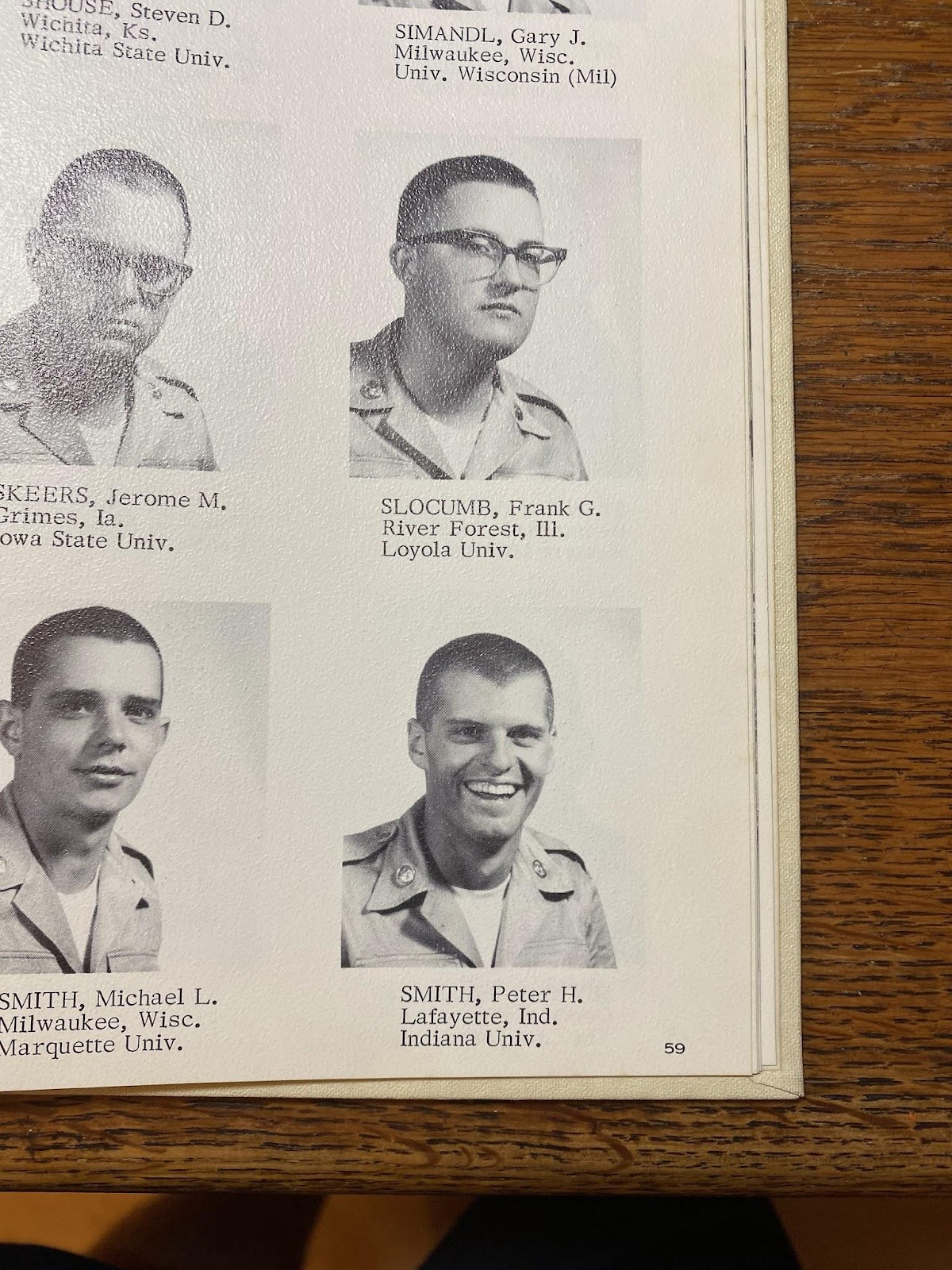
I graduated from Indiana in 1967 with a degree, with honors, in history and a reserve officer training candidate (ROTC) commission.

Indiana University Senior Portrait From School Yearbook, 1967
(Pete Smith Next to Last Row On Left)
I went on Army active duty in September, reporting to quartermaster officer basic training at Fort. Lee, Virginia. located in Petersburg. As I pulled into Petersburg, I recall a sign at the local Holiday Inn welcoming the Daughters of the Confederacy which set off some alarms as my New England ancestors had fought for the Union. Most of my officer basic classmates were recent college graduates with ROTC commissions like me. I was assigned to an officer training barracks and befriended a black guy from Michigan State University. After a few weeks of meals on base, he and I decided to go to Petersburg for dinner at a place our captain recommended. It turned out to be an old home turned into a restaurant. My friend and I went there on a Saturday night and were greeted at the door by a black maitre d’ dressed in a red sports coat and tie. When I asked for a table for two, the maitre d’ hesitated, looked nervous, and told us to wait in the entryway. Soon an elderly woman, who was the owner, appeared and stared at us with an icy, bitter look on her face. She told us in a very irritated voice that my friend was the second one (meaning black) that had come to her “house” since he (meaning President Johnson) passed that law (the Civil Rights Act of 1964). My friend looked at me and said let’s leave. I felt provoked and angry and convinced my friend to stay. I then insisted we wanted a table. The customers were all white and I felt the tension in the air as we were seated. The waiters were all black and were dressed in red sports coats and ties and looked very nervous. Our waiter’s hands were visibly shaking as he took our order. We finished our meal and left and the owner glared at us all the way out.
Fast forward to 1973, I went to work for the Monsanto Company law department in St. Louis. At a fall retreat in 1977, our general counsel introduced Clarence Thomas as a new addition to the all-white law department. I was the only attorney to go up to Clarence and talk with him about his background and what to expect. We became friends and I helped him take over my position in 1978 when I got promoted. We stayed in touch for many years afterward.
Fast forward to 1973, I went to work for the Monsanto Company law department in St. Louis. At a fall retreat in 1977, our general counsel introduced Clarence Thomas as a new addition to the all-white law department. I was the only attorney to go up to Clarence and talk with him about his background and what to expect. We became friends and I helped him take over my position in 1978 when I got promoted. We stayed in touch for many years afterward.

Me with Supreme Court Justice Clarence Thomas in His Chambers, 2000
Looking back, these experiences taught me that principles are easiest to defend in theory and much harder to defend when they involve real people, real friendships,, and real consequences. I did not always know the right answer, but I tried to act consistently with my sense of fairness.