In the spring of 1965, I faced one of the most important decisions of my young life. The Vietnam War was expanding, anti-war sentiment was growing on college campuses, and I had to decide whether to continue in Army ROTC and pursue a commission as an officer. The military draft and being sent to Vietnam were clear and present facts of life.
In 1963 and 1964, as a freshman and sophomore at Indiana University, I participated in the compulsory Army Reserve Officers' Training Corps (ROTC) program. During those years I had never known a time when there was no military draft and college gave me a draft deferment. I felt a sense of duty as I enrolled at IU, so no big deal.
I was issued an Army uniform and required to wear it once a week on ROTC drill days. Our drill instructors were Army sergeants, most of whom had never been to college. Many of us were liberal arts majors with no clue about military discipline, uniform inspections, or marching. Each week there was a litany of yelling during inspections about unshaven, sloppily dressed, and downright degenerate young men. We generally just agreed and sucked it up.
I certainly didn't enjoy the activities, which to my way of thinking were a mindless waste of time. Yet, we did little that could be described as physical. Mostly we marched in straight lines of three or four individuals, while someone shouted nearly indecipherable commands. Sometimes I was even asked to command these little squads, which I did by trying to imitate the nearly indecipherable sounds of our older sergeant. I was not good at imitation-evidently as I remember marching a group of us into a sand pit and not knowing how to stop or turn the group around. Sergeant yelling and an eye roll followed.
One day we were handed M1 rifles and asked to take them apart. I was terrified, but I was able somehow to dismantle the thing; but when asked to put it back together again, was completely stymied. After a seemingly interminable time, during which everyone else had managed to transform the pieces back into rifles, I had no choice but to hand in the parts. Nothing was said.
At the end of my sophomore year, I faced a choice of continuing ROTC for 2 years and becoming a commissioned officer or dropping out of ROTC. It was the spring of 1965 and the Vietnam War was ramping up, along with campus anti-war sentiment. I was having long late-night conversations with my classmates about what to do about advanced ROTC, the draft, and draft deferments. Advanced ROTC meant joining the military and possibly being sent to Vietnam. It was a defining moment in my life.
I reasoned that if for some inexplicable reason, I was drafted out of the university or if the war were to continue to ramp up as it did after my graduation year, I would be better off as an officer. But the bell rang and light went on for me one evening when a fraternity brother emphasized that advanced ROTC would pay me $40 a month. I needed the money so the next day I signed up. Talk about naive, and impulsive! I hadn’t consulted my parents or any other person with perspective or wisdom. I was in the Army now. Reflecting back now, I feel much of the decision was also following a path of duty like it was a game with rules. Reality taught me it was a debt paid in blood.
The summer of my junior year I had a six-week summer camp as part of my military obligation at $40 a month. This is the ROTC summer camp that all ROTC cadets are required to complete. Summer camp was at Ft. Riley, Kansas, and was my first real taste of the military. Ft. Riley was hot. Hot like an average temperature of over 100 degrees for the entire week three of training to the point where the Army cadre stopped training one day because of heat exhaustion by many cadets.
The physical training was the most strenuous and exhausting I’ve ever experienced. Up at 3:30 a.m. to make our beds, use the latrine, shave, and get dressed for inspection. All this as we attempted to get ready for another training day by 4 a.m. Training began with calisthenics and a 5-mile run. No break and then lining up for breakfast soaked with sweat and doing or being severely demeaned for not doing 10 pull-ups before entry to the mess hall. Then a server slapped a scoop of SOS (a dish consisting of a cream sauce with meat in it poured over toast) on my tray. My sweat would drip all over it as I tried to eat it in 10 minutes. After breakfast, we were marched to a class on military tactics, weapons, field fortifications or some other subject long forgotten where a number of us would doze off only to be rudely awakened by our Sargeant. We would march swiftly everywhere and keep going all day, with breaks only for lunch and dinner.
Night exercises would normally follow for compass reading (and I always got lost) or maybe a night assault. I remember one cadet designated company commanding officer lined us up for a night attack and at the time of attack yelled charge like in the movies. The training was stopped and the Army cadre told us we were all dead because we lost our surprise and the enemy would be ready for us. The lyrics from the Buffalo Springfield song “For What It’s Worth” came to mind- There is a man with a gun over there telling me I got to beware. There was a sense of apprehension and fear in the air from that point on.
I remember peer pressure pushing me beyond preconceived physical limits; being really thirsty, unlike any other thirst in my life before or since; digging a foxhole in the middle of some God-forsaken scorched-earth pasture. I would occasionally see a dwelling on the post and repeatedly dream of its air conditioning and a cold drink. One time coming back to the barracks after a long training day, I sat down in the canteen to drink a glass of cold soda. It was warm and a guy next to me said the beer was cold. I then opted to take my first ever glass of beer, cold beer, and to this day I prefer a cold beer to any other drink.

Ft. Riley Cadet Barracks Activities From ROTC Summer Camp Book, 1966
After our fourth week of training, we were given a pass to leave the fort from noon on Saturday until noon on Sunday. Four of us rented a hotel room, turned the air conditioner way up and mostly they drank a case of beer while I slept. We didn’t leave the room except to eat.
While I may not have been a changed person when I returned to school for my senior year, the summer camp had a profound effect on me. I realized for the first time that it was serious business. The instruction was geared to enable us to kill others so I and those I was responsible for could live to fight and kill another day. Coming to grips with mortality as a young man can be sobering, especially if there is a war going on and the chances are good you’re going to participate in it, which I did.
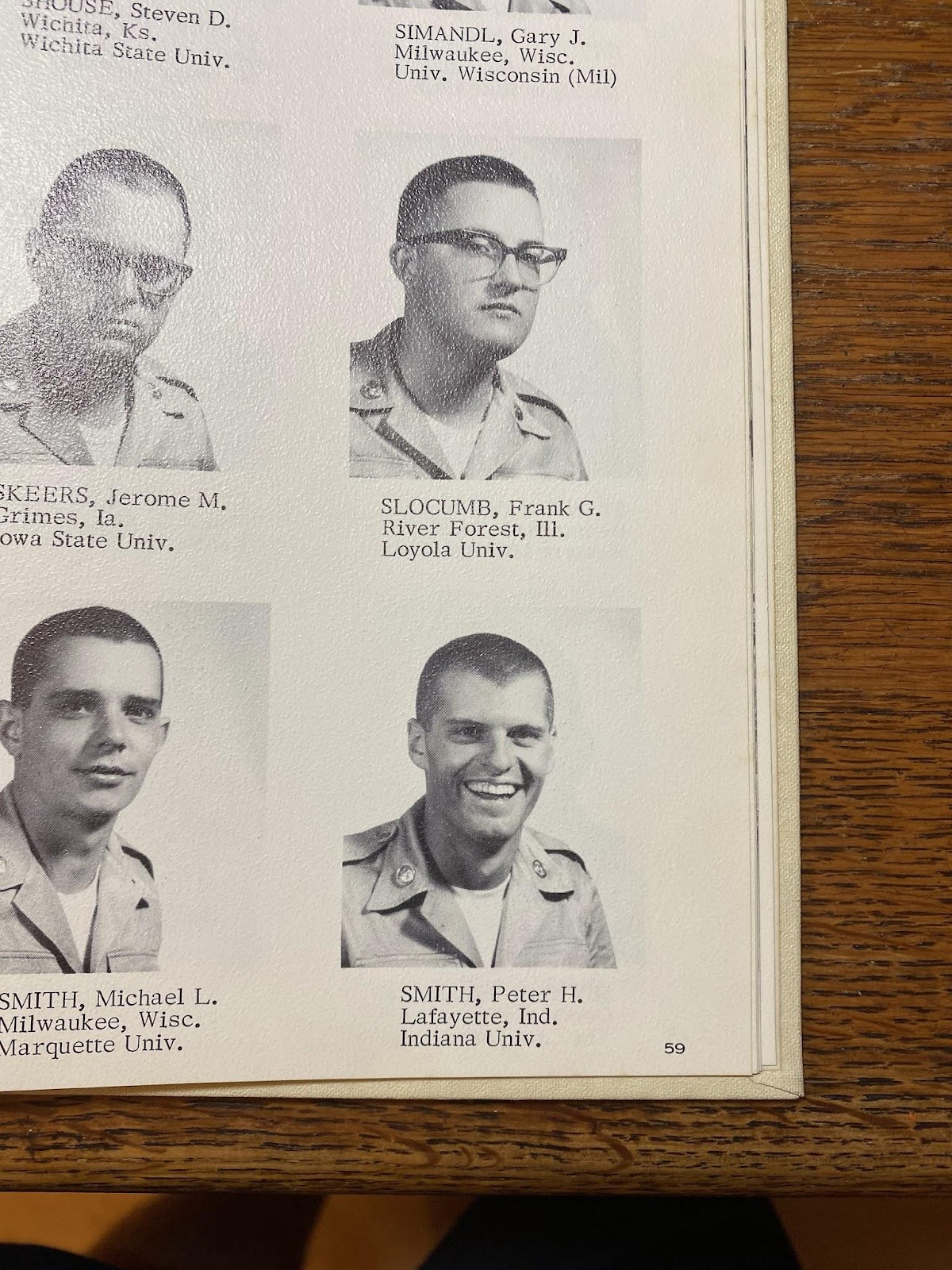
Ft. Riley Cadet Portrait From ROTC Summer Camp Book Book, 1966
I returned from ROTC summer camp to Indiana University in the fall of 1966 for my senior year and graduation.

Mom and Me, Indiana University Graduation, 1967
After four years of ROTC classes at IU and an ROTC summer camp at Ft. Riley Kansas, I was presented my Commision as a Second Lieutenant in the United States Army. It was a rite of passage. While I felt a strong sense of pride and exhilaration for meeting all the physical and academic demands, this was balanced with a deep solemnity and a heavy burden of responsibility.

Commission as a Second Lieutenant in the U. S. Army, June 12, 1967
Looking back, I have no regrets. ROTC exposed me to discipline, responsibility, leadership, and the realities of military service. More importantly, it prepared me mentally for what lay ahead. Although I could not know it at the time, the lessons learned at Fort Riley would soon be tested in Vietnam.


