Showing posts with label Cochlear Implant. Show all posts

Sunday, December 8, 2024

My Hearing Story (2014-2022)


By 2021 I could still hear sounds, but increasingly I could not understand words. Conservations became exhausting. I found myself asking my wife to accompany me to doctor appointments because I could not listen, think about what was being said, and remember it all at the same time. Hearing loss was slowly shrinking my world.

I lived my life until 2014 feeling I had good (or at least good enough) hearing even as the feedback I started getting from friends and my surroundings proved otherwise.   I was self-conscious and resistant to the idea of using assistive devices, feeling that hearing aids were too expensive, complicated, and uncomfortable and would make me look older.  But as I was having to constantly ask people to repeat themselves I realized that already made me seem old.  As a docent, I sometimes struggled to understand visitors' questions in crowded exhibit areas. I began worrying about embarrassing myself and gradually cut back my volunteer activities. I was also starting to withdraw from social group activities and isolating myself and knew that was not a good thing for a happy life.

Then I learned that the Veterans Administration covered hearing aids.  I promptly got an appointment with a VA audiologist at the Santa Ana Clinic.  She said my hearing loss was moderate in my right ear and slightly worse in my left.  I remember the appointment when I got my hearing aids.   I was able to hear people speaking all around me.  I also began hearing bicycle riders coming up behind me on the bike paths. 

Even using hearing aids I found the music very hard to hear. It was beginning to sound more like noise.  I couldn’t use my cell phone unless I used my hearing aid Bluetooth function or I put the phone on speaker and my wife carried on the conversation on my behalf.  In one-on-one conversations, I relied heavily on reading lips.  It was not something I was conscious of doing but as soon as someone looked away, wore a face mask, or it was dark and I couldn’t see their lips, I realized I was doing it.

My wife suggested I get a hearing evaluation by a hearing medical doctor she knew, Dr. William Luxford, at the world-renowned House Ear Clinic in LA.  He told me I had severe to profound hearing loss (10% word recognition) in my left ear and moderate hearing loss in my right ear (about 50% word recognition).  He was very optimistic I was an excellent candidate for a left ear cochlear implant or CI and said the surgery risk was small.  However, he said I did not qualify under Medicare guidelines for a CI because while my left ear qualified my right ear did not, so the CI surgery would cost me $30,000-$50,000.  He did suggest I have my hearing evaluated by the VA as they might have a different CI qualification.  I was evaluated by the VA in January 2022 and told I did not qualify- similar to the Medicare guidelines but could be re-evaluated in 6 months.

I began to think and learn about cochlear implants.  
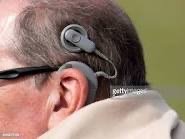
                                                          Photo of a Cochlear Implant Processor Above the Ear

Cochlear implants use a sound processor that fits behind the ear. The processor captures sound signals and sends them to a receiver implanted under the skin behind the ear. The receiver sends the signals to electrodes implanted in the snail-shaped inner ear (cochlea).

The signals stimulate the auditory nerve, which then directs the signals to the brain. The brain interprets those signals as sounds, though these sounds won't be just like natural hearing.

It takes time and training to learn to interpret the signals received from a cochlear implant. 

My mind started to go through a pro and con evaluation process.  CI surgery damages part of the ear and there is little or no residual hearing left which means that things like hearing aids will never work on the ear again, nor would I be able to take advantage of future stem cell or other technology that might require an intact ear.  Once I had CI surgery I would be deaf in that ear so there is no return if the CI fails.  And aesthetically the CI processor is visible above my ear.  

Then I began thinking of all the things I was missing.  I understood very little conversation in my left ear and would still have a hearing aid in my right or good ear.  Hearing loss meant less stimulation for my brain, but also more social isolation which is being linked more and more to cognitive decline. I had stopped going to church, working as a Docent at the Nixon Library, going to group events, and even limiting my bicycle riding for safety reasons.  My hearing made my conversations with my wife a constant source of frustration.  I was withdrawing from activities I loved. Conversations with my wife were becoming frustrated. I was becoming depressed and unhappy.  

What did I have to lose?  

Dr. Luxford had told me the longer I waited, the more my auditory nerve would deteriorate.  The better the nerve, the better I would do with the implant.  Plus the CI implant processor worn on the outside is constantly being improved.  I talked to several CI recipients and those conversations were very persuasive.  They could hear everything I couldn’t and their spouses were also very happy.  Visually the processors were about the size of a quarter and looked like a button.  I finally convinced myself that overall the hearing improvements a CI offered outweighed the surgery risk and other negatives of a CI.   I would be happy to assume the risks because the hearing improvements will be now and at my age time is of the essence.

In May 2022 I got Covid and tested positive for 11 days.  Studies are showing that long Covid affects smell and taste but only anecdotal information that it affects hearing.  In August the VA retested my hearing and my hearing loss since January was more than enough to qualify me for VA CI surgery.  When the VA told me in August 2022 that I now qualified for a cochlear implant, I felt both relief and apprehension. Relief that help was finally available and apprehension because I now had to decide whether to go through with the surgery. Finally, after waiting for a CI doctor appointment until December, the surgeon gave me a February 2, 2023 CI surgery date.

The VA audiologist asked me to choose from two CI manufacturers- Advanced Bionics and Cochlear Americas.  I determined both were good technology but based on conversations with CI recipients I felt more comfortable with Cochlear Americas.  They were the oldest and largest company, my stepson had a Cochlear Americas CI as did a relative from my wife’s family who wore a very small processor requiring no earpiece, which I liked.  Both were very happy with their CI so I chose Cochlear Americas. 

Looking back, I learned that pride and denial can delay needed change. The hardest part of hearing loss was not the inability to hear sounds- it was the gradual shrinking of my connections to other people.

I will talk about the CI surgery and rehab in a future story.


Saturday, December 7, 2024

My Hearing Rehab Story 2023

On March 5, 2023, after four weeks of recovery from cochlear implant surgery, I sat in a VA audiologist's office waiting for him to turn on my implant. I had spent months researching cochlear implants and wondering whether I was making the right decision. Now there was no turning back.  

A CI uses two primary parts. One part is surgically implanted into the inner ear and acts as a type of receiver and stimulator, sending electrical “sound” signals to the inner ear hearing nerve via implanted electrodes.  These signals stimulate the hearing nerve that sends the impulses to the brain where the electrical impulses are perceived as sounds. The second part of a CI is worn outside behind the ear. It contains a microphone and receiver, an antenna, and a speech processor. The transmitter and receiver both contain magnets that attract to each other to stay aligned and keep the two communicating across the intact scalp.

I had CI surgery on February 2, 2023, at the Long Beach VA Hospital.  It was a fairly routine outpatient surgery, lasted about an hour, and was performed under general anesthesia.  The surgeon made a small incision behind my left ear, placed the receiver implant under the skin, and then inserted the electrodes into my inner ear auditory nerve.  I woke up a short time later in recovery with a very sore jaw and couldn’t open my jaw very wide for a week or so.  They put a cone-like cover over my ear.  My wife met me outside the recovery room and drove me home where I took a pain pill for the sore jaw.  For the next two weeks, I had periodic dizziness, jaw pain, and some nose blood, and slept a lot.  Then came two more weeks of waiting for the surgery to heal until the VA audiologist activated or turned on my left ear.  I have no residual hearing now in my left ear.


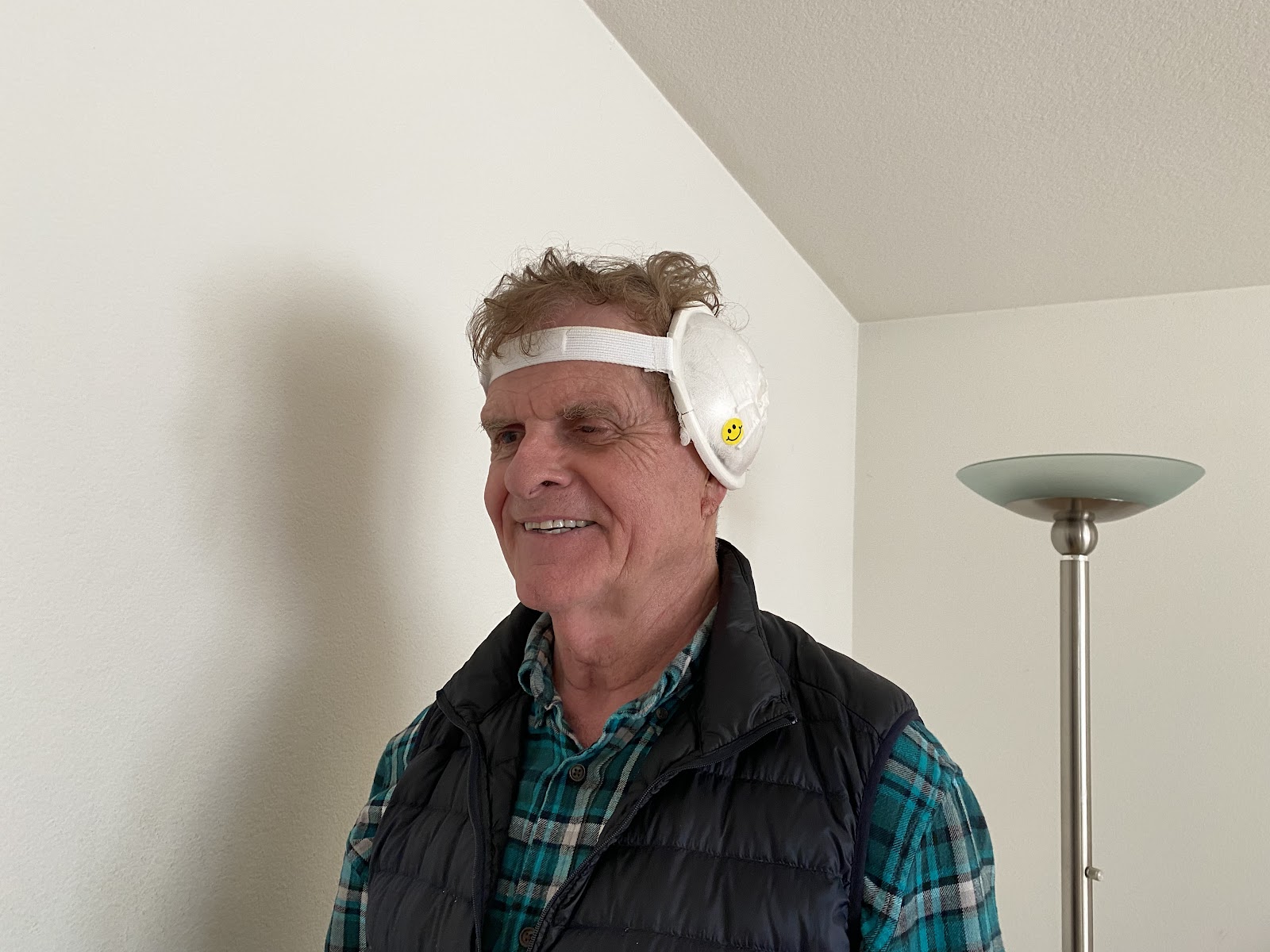
Me Post Cochlear Implant Surgery, 2023


Finally, on March 5, 2023, I visited the VA audiologist and he activated or turned on my CI.  That is, he connected my external sound processor behind my left ear, switching it on.  I was excited, nervous, and a little afraid of being disappointed.When he first spoke the sound processor captured the sound signals and sent them to the receiver implanted under the skin behind my ear.  The receiver sent the electronic signals via implanted electrodes to my inner ear hearing nerve, which then directed the signals to my brain.  

My brain interpreted these signals as intermittent, robotic, tinny sounding static.  It was very different from natural hearing and I knew it would take months of practice, patience, and persistence for the auditory nerve and brain to process the electronic signals it was receiving and transmit them as meaningful speech.  One thing I noticed immediately is how loud I was speaking (as I likely did when I wore hearing aids) and now I find myself slowly starting to talk softer.  My voice also sounded like I was in a deep well.

As my appointment came to an end, I received a huge backpack filled with boxes of CI external electronic equipment and accessories, such as processors, a processor remote control, batteries, battery chargers, a TV streamer with cables, a small microphone, and lots of plastic packages.  All this equipment is to enhance my hearing function and is overwhelming.  I have spent frustrating hours trying to call the company tech help and my son to figure out how to use it.


Me at Cochlear Implant Activation, 2023


How to explain the rehab process?  I have been going through it for six weeks now and my progress toward a goal of being able to hear words clearly through my CI is slow and frustrating.  My brain was very confused in the beginning as it had never heard of using this kind of technology before and it had to learn how to use it.  And unlike hearing aids, getting a CI is not an instant hearing result.  On a scale of one being deaf and ten being perfect hearing, I began at two.  

My initial hearing rehab began at 1-2 hours a day about a week after activation as I needed to train my brain to use this new way of hearing and figure out the electrical equipment.  About an hour a day, I would listen through a Bluetooth iPhone connection to an audiobook and read along with the hard copy.  Each day my wife would read our daily devotional as I read along.  I also watched closed-caption TV.  Gradually, I began to associate the tinny static sound I was hearing with a word or phrase from my memory of those sounds.  The frustration was that the clarity came initially at an agonizingly slow pace and was intermittent.  But I persisted and practiced each day.

At week four I went to see the audiologist for mapping or adjustments to the equipment.  I went into a hearing booth for a CI hearing frequency test and listened to soft sounds, pushing a button when I heard anything.  He compared the results with my pre-CI frequency test audiogram and said my CI ear had improved at the top level he had seen at my post-activation stage.  He adjusted the processor so it sounded a little better.  I’m pretty sure I couldn’t stop smiling.   Actually, I’m not sure I’ve stopped yet.  

In the past few days, I have started doing the rehab with my CI processor on and no hearing aid in the other ear.  By removing my hearing aid, I am forcing my brain to use my CI.  It felt like taking the training wheels off a bicycle. The hearing aid was my safety net. Removing it forced me to depend entirely on sounds that still seemed artificial and unfamiliar. My goal is to be able to go the entire day with only the CI processor on and no hearing aid.

So how long will it take for me to understand speech clearly with my CI alone?  Each person is different but my goal is six months based on other CI recipient experiences.  What I am finding are small plateau improvements.  I hear with only the CI the sound of the wind, and understand many of the daily devotional words, and some TV dialogue without looking at the words or closed captions.  

I still have difficulty understanding telephone conversations, conversations with background noise and conversations in restaurants.  Music is the most difficult for me to hear- both melody and lyrics.  My hope, listening to stories of past CI recipients, is to hear so much better speech and music in these environments.   My admonition to those who decide to get a CI is to adopt a positive mental attitude that you will have success as long as you pursue rehab with patience, practice, and persistence.  To me, I want to improve the quality of my life, interact with my family and granddaughter in group outings, enjoy OLLI and socialize in general. 


Looking back, I learned that cochlear implantation is not really a surgery story. It is a persistence story. The surgery lasted an hour. The rehabilitation lasted months and continues today. Every small improvement came through patience, practice, and persistence. For me, the goal was reconnecting with people, conversations, and activities that make life meaningful.


Editor's note (2026): Since writing this story, I have received a second cochlear implant in my right ear and continue my hearing rehabilitation journey.